Judgment 2, Technology 3 (After Review)
The human was on the pitch the whole time. He just stopped playing

I watched it the way every Egyptian watched it. Standing up before the ball even crossed the line.
58th minute in Atlanta..Egypt already up 1-0 on Argentina.
On the reigning world champions, in a World Cup knockout match. Then Mostafa Zico breaks away and finishes, and for about four minutes my country had a 2-0 lead over Lionel Messi. Shirts off.
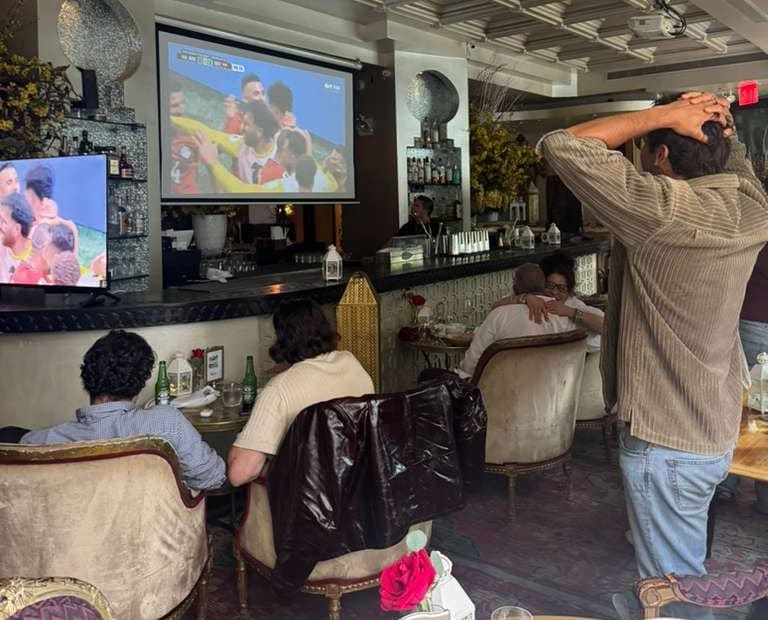
Screaming in living rooms from Cairo to Alexandria to every Egyptian household abroad. That goal happened. I saw it. A hundred million of us saw it.

Then the referee put his hand to his ear.

You know the ritual by now.
The rectangle drawn in the air.
The slow walk to the pitchside monitor.
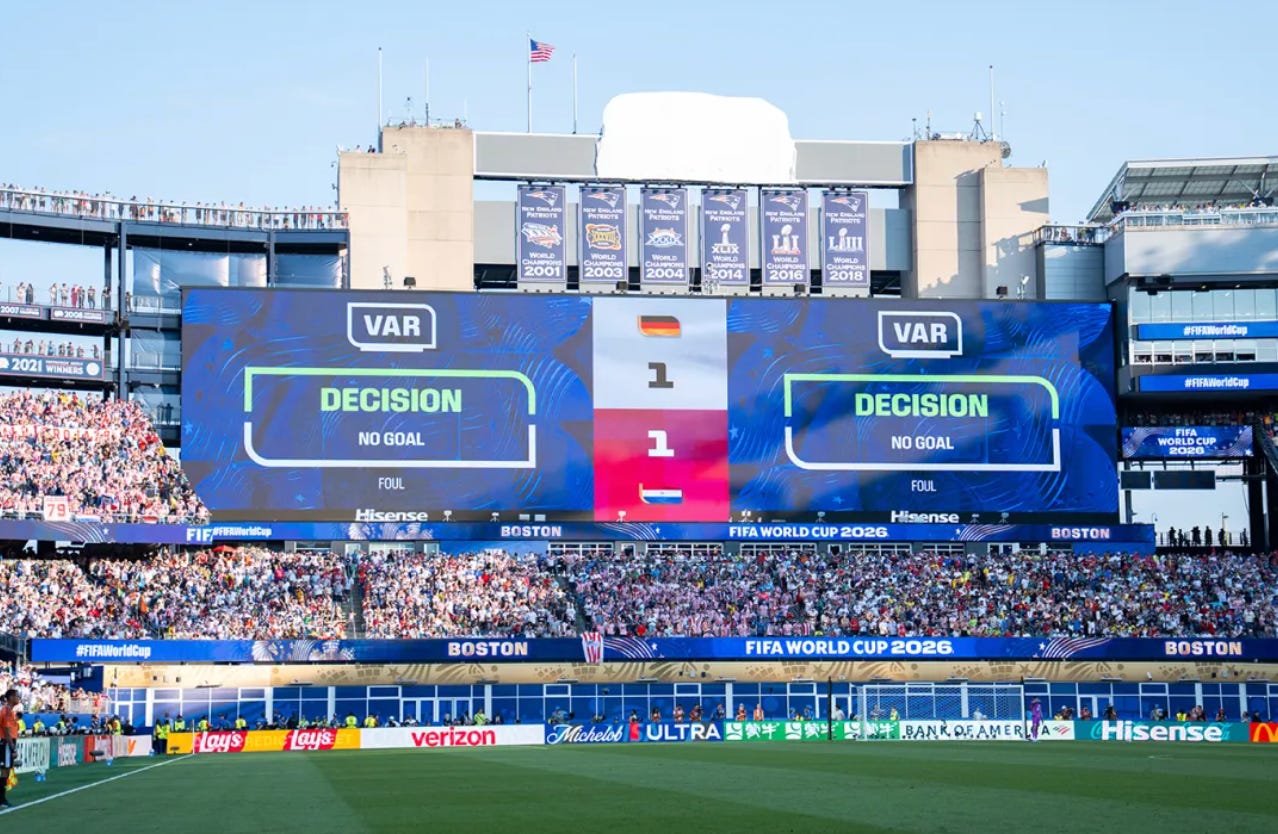
The stadium screen replayed a moment nobody in the ground had noticed and then François Letexier came back and erased the goal, because seconds earlier, a full pitch away from where Zico scored, Marawan Attia had tugged Lisandro Martínez’s shirt and stepped on his foot.
Egypt scored again ten minutes later but it didn’t matter.
Argentina came back and won 3-2. Cristian Romero in the 79th, Messi in the 83rd, then the winner. Egypt is out..and I’ve spent every hour since thinking about that walk to the monitor.
Not because of the result. Because of what the walk did.
This isn’t an article about whether the call was right
I know that’s what you expected, so let me kill it early.
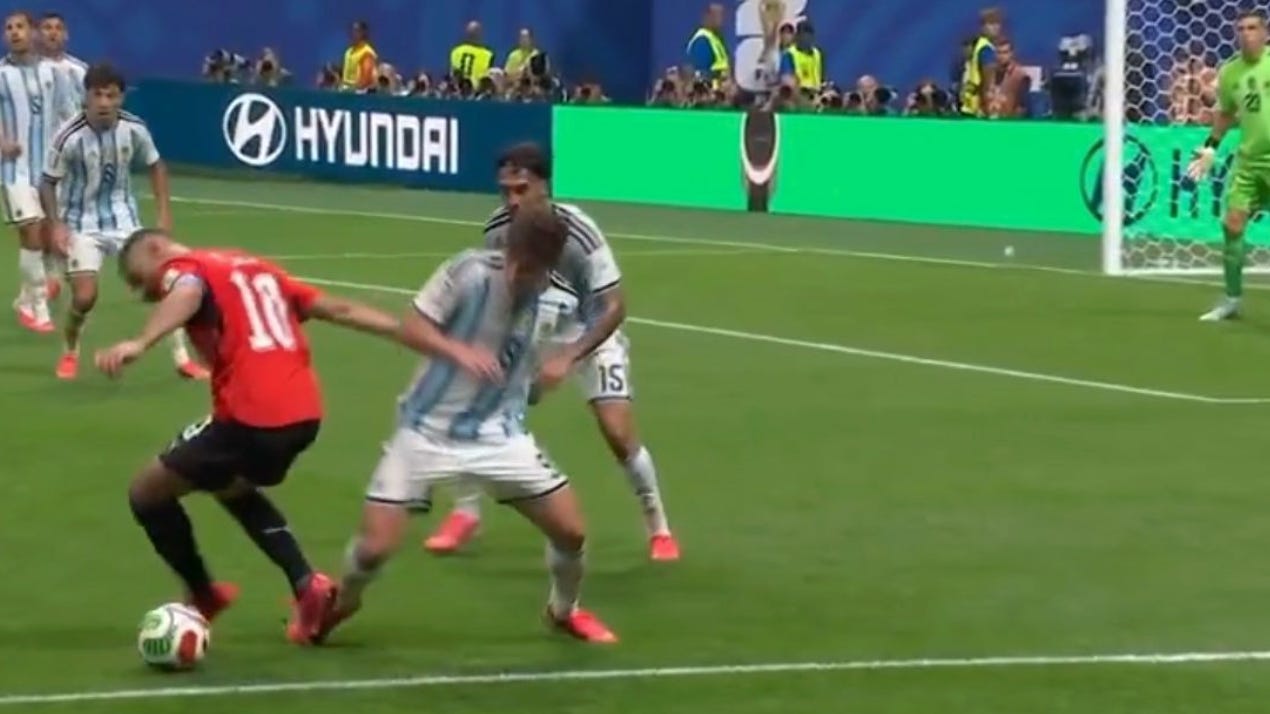
Was it a foul? Genuinely debatable.
ESPN’s VAR review called it a correct intervention. Mark Clattenburg, a man who refereed a Champions League final, said he didn’t believe it was a foul and didn’t believe VAR should have intervened at all, pointing out that referees had been letting far more physical contact go all tournament.
Fox’s rules analyst Joe Machnik said the intervention fit the protocol.
Rob Green said on the live broadcast that the incident was surely outside VAR’s realm, a full length of the pitch away.
Ian Darke wondered aloud how far back a review is even allowed to reach, and noted that goal would have stood for the previous 150 years of football.
Read that list again. These are the most qualified football-officiating minds in the English-speaking world, and they split roughly down the middle.
Which means one thing, and I want to be precise about it: this was a judgment call. A close one. The kind reasonable experts disagree on.
So why did it feel like a verdict?
The screen doesn’t settle arguments but it ends them.
Here’s what actually happened in that stadium, stripped of the theatre.
A human in a video booth formed an opinion about a marginal contact. He recommended another human go look at a screen. That second human, Letexier, watched slow-motion replays of an incident he’d already seen live and chose not to whistle, and then changed his mind.
Two humans with two opinions and that’s the entire event.
But that’s not what it looked like. What it looked like was: the technology found something. The replay, the freeze-frame, the zoom, the official walking back with the authority of the machine behind him. The whole choreography is designed to convert an opinion into a finding. Before VAR, a referee who disallowed that goal would’ve had to own it, and every pundit, player, and fan would’ve argued with him.
Now? He didn’t make a call. He confirmed what the system showed.
Who are you arguing with, exactly? The footage?
And this is the part almost everyone gets wrong about VAR, so I’ll say it plainly.
The danger was never machines replacing human judgment. The danger is humans making judgments and then using machines to make those judgments look inevitable.
Slow motion makes light contact look deliberate. A freeze-frame makes incidental look intentional. Anyone who’s watched a replay of themselves knows this.
Technology doesn’t show you the truth.
It shows you footage, at a speed and angle that a human chose, framed by a human who already suspected a foul. The certainty is manufactured. The judgment is exactly as human as it was in 1986.

Egypt’s coach Hossam Hassan understood this instinctively. He refused the polite script after the match.
“We have been treated unfairly today. We have suffered injustice,” he said. Notice he didn’t say the machine got it wrong. He said we were treated unfairly. He knew someone did this. Not something.
A human in the loop is not the safeguard you think it is
The standard defense of VAR is that a human always makes the final decision. The referee goes to the monitor. He can decline. There’s a human in the loop.
Sure. Technically true..and almost meaningless.
Because the real question isn’t whether a human is present. It’s what happens to that human once the system has spoken.
Does he still judge?
Or does he ratify?
Does he own the decision, or does he inherit the machine’s confidence and hide inside it?
Researchers have a name for this: automation bias. It’s the well-documented tendency of humans to defer to automated systems even when other signals contradict them, and it’s been found everywhere from cockpit navigation to public-sector casework puts it bluntly: even when humans have full discretion to override a system, oversight tends to collapse into a rubber stamp, because people reduce their own scrutiny the moment a system has produced an answer.
Think about the actual mechanics of Letexier’s position at that monitor. A colleague has already flagged the incident as a probable foul.
The footage has been pre-selected to show that foul.
Eighty thousand people are watching him watch it.
In the entire history of VAR, on-field referees overturn the booth’s recommendation so rarely it’s practically a rounding error.
Is that a man exercising judgment? Or a man completing a procedure?
I think he ratified.
I think most humans in that position ratify. And I don’t even blame him, which is what makes it worse. The system is built so that ratifying is the path of least resistance and dissenting is a career risk.
Meanwhile, an Al Jazeera analysis noted that a similar-looking contact on Mohamed Salah before Argentina’s third goal got no VAR intervention at all.
Same match with the same technology but different human choices about what deserved the screen. The system didn’t produce consistency. It produced selective certainty, deployed at human discretion, wearing the costume of objectivity.
You won’t lose a goal. You’ll lose a job, a loan, a diagnosis.
If this were only about football, I’d grieve for a week and move on. It isn’t.
The exact structure of that moment in Atlanta is being installed everywhere right now. A system screens, scores, flags, or recommends. A human sits at the end of it, nominally in charge. And once the system speaks, the human’s role quietly shifts from deciding to confirming.
A candidate gets screened out by a resume filter, and the recruiter who never sees the CV feels no responsibility, because the system ranked them low. A patient gets deprioritized by a risk score. A loan gets denied. An insurance claim gets rejected.
An employee gets a performance number. In every case there’s a human in the loop, and in every case that human can point at the output and say what Letexier’s body language said in Atlanta: I didn’t decide this. It was found.
That’s the trade we’re sleepwalking into. Not humans versus machines. Humans hiding behind machines. Judgment with the accountability stripped out.
And Egypt’s goal is the perfect specimen because the stakes were visible. A hundred million people watched a debatable human opinion get laundered into an unappealable fact in under three minutes, live, in 4K.
When the same laundering happens to your job application, there’s no stadium screen. There’s no Clattenburg going on television to say the intervention shouldn’t have happened. There’s just a decision that feels official precisely because a machine touched it on the way through.
Keep the technology. Return the ownership.
I’m not arguing to unplug VAR, and I’m definitely not arguing against AI in hiring or medicine or anywhere else. Systems catch things humans miss. That’s real.
What I’m arguing is simpler and harder. A recommendation from a system should raise the burden on the human, not lower it. If Letexier overturns his own live call after watching a screen, he should have to explain why his eyes were wrong the first time, in his own words, with his own name on it. If a recruiter rejects a candidate a model flagged, that rejection should be the recruiter’s, defensible by the recruiter, appealable to the recruiter.
The moment “the system found it” becomes an acceptable full sentence, judgment hasn’t been improved. It’s been orphaned.
Egypt didn’t lose to technology on Tuesday.
Egypt lost to two Frenchmen’s opinions, dressed in technology’s clothes. The first is football. The second is the blueprint for how every consequential decision in your life is about to be made.
I’d rather be beaten by a man than corrected by a screen. At least the man has to look at you.
Feels like the final score every time a human "reviews" a machine's decision in under a minute.
The fix as written only burdens one direction. Overturning the flag requires justification. Following it doesn't. That's not symmetric accountability, it's a built-in incentive to always ratify, since agreeing with the system stays cost-free and disagreeing is the only path that creates exposure.
This is already the pattern in medicine: clinicians increasingly follow decision-support tools specifically because deviating creates liability if they're wrong, while following the tool is defensible even when the tool is wrong. Apply that same shape to hiring or refereeing, and the fix accelerates the exact problem it's meant to solve.
The requirement has to run both ways. Agreeing with a bad flag and being wrong needs to cost something too, not just disagreeing and being wrong. Otherwise "defensible and appealable" becomes a form filled out the same way regardless of what actually happened in the person's head, the same rubber stamp, just with more paperwork attached.