I expected AI to replace people...
Instead, it just sped up the chaos that was already there.

Here’s a sentence I never expected to write: AI didn’t replace anyone at the company I keep hearing about most this year. It just made the existing mess move faster.
I’ve spent the last few months watching organizations pour money into AI agents expecting the arithmetic to be simple, with fewer humans, more output, and lower cost. But that’s not what I’m seeing.
What I’m actually seeing is companies handing every employee something closer to unlimited capacity, and then acting shocked when unlimited capacity produces unlimited chaos.
This isn’t an AI problem, but a management problem wearing a very expensive disguise.
Here are the 7 places I keep seeing human dysfunction and AI dysfunction rhyme with each other, almost note for note.
1. Bad instructions don’t get better with more compute
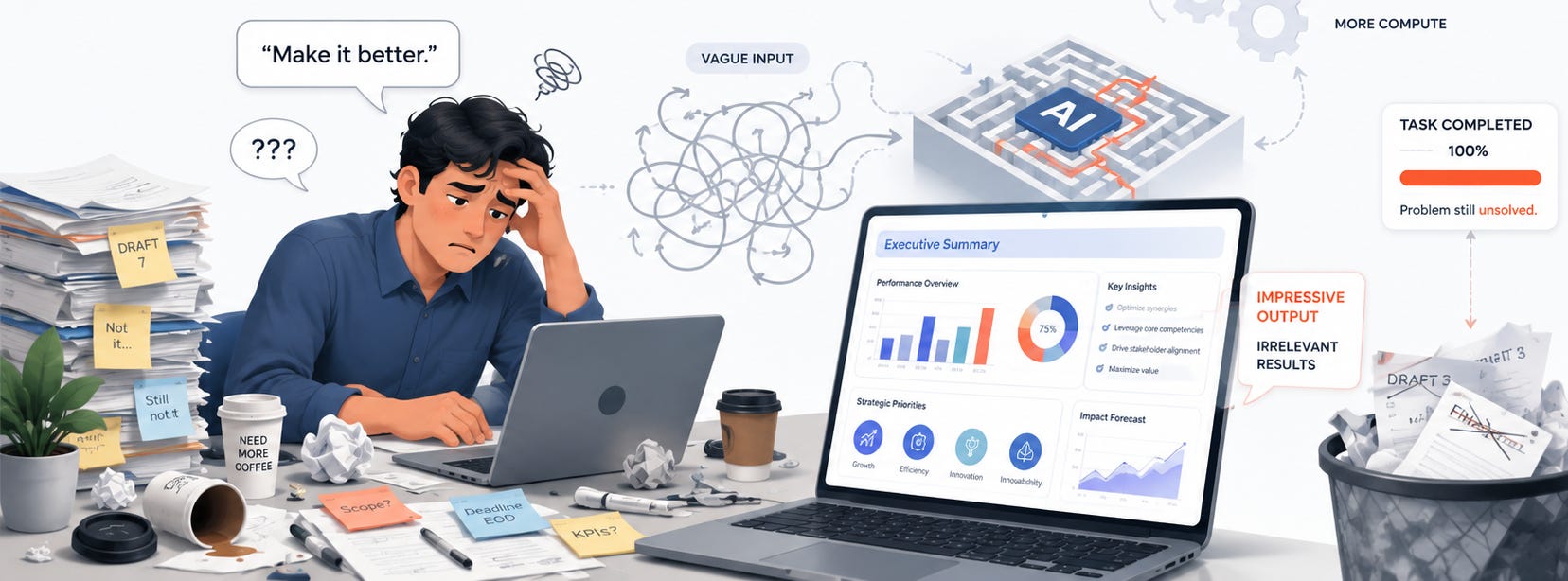
Give a new employee a vague brief, and they’ll produce vague work. Similarly, give an AI agent a vague prompt, and it will produce something that looks like work: confident, formatted, complete, while solving nothing.
I’ve sat in rooms where teams doubled and tripled their AI spend trying to fix output that was never a capability problem in the first place. It was a clarity problem, and nobody had actually done the hard work of articulating what “good” looks like before asking the system, human or machine, to go produce it.
More budget doesn’t fix an unclear brief. It just makes the unclear brief more expensive.
2. Endless meetings and endless retries are the same disease
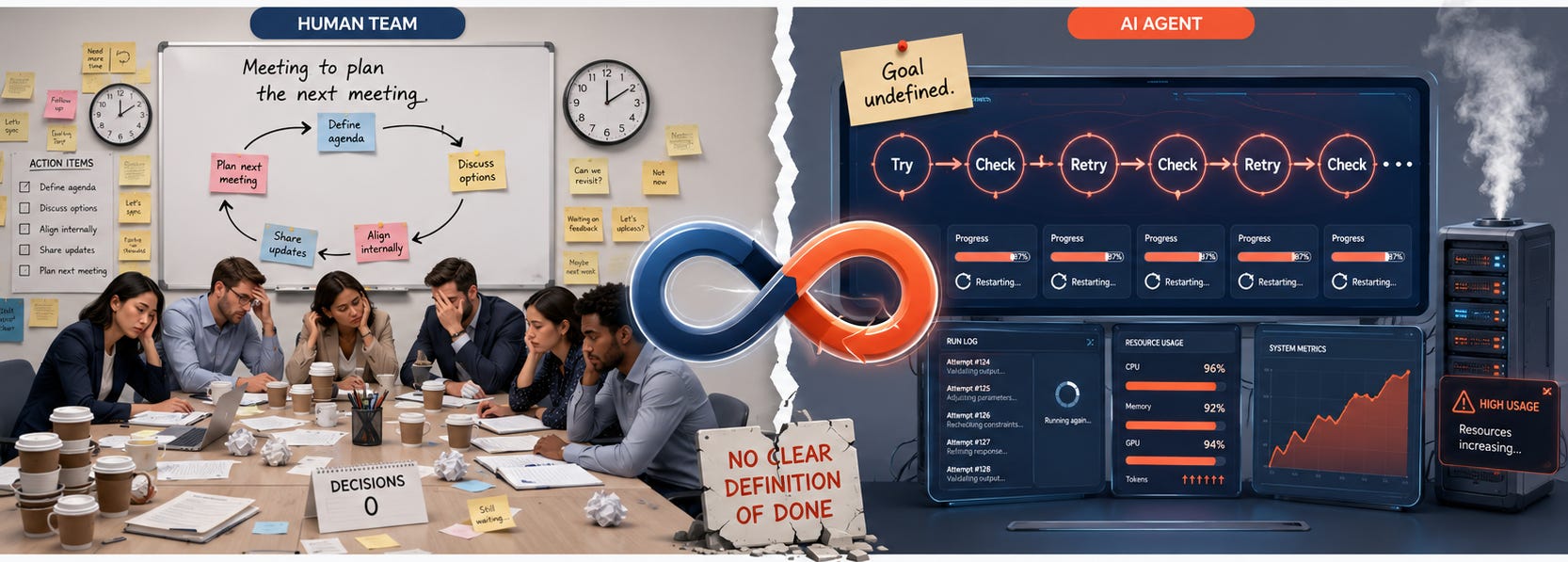
You know the meeting that exists to plan the next meeting. The one where nothing substantial gets decided, just re-discussed.
AI agents do this too. When a task isn’t defined cleanly, the system doesn’t fail loudly, but it loops. It tries, checks its own work, tries again, checks again, and burns enormous resources arriving nowhere, because nobody told it what “done” actually meant.
A team stuck in meetings-about-meetings, and an agent stuck in a self-correcting loop are the same failure. Neither is a technology problem, and both are the cost of skipping the hard work of defining the task before you start.
3. Most of the activity in your organization isn’t doing anything
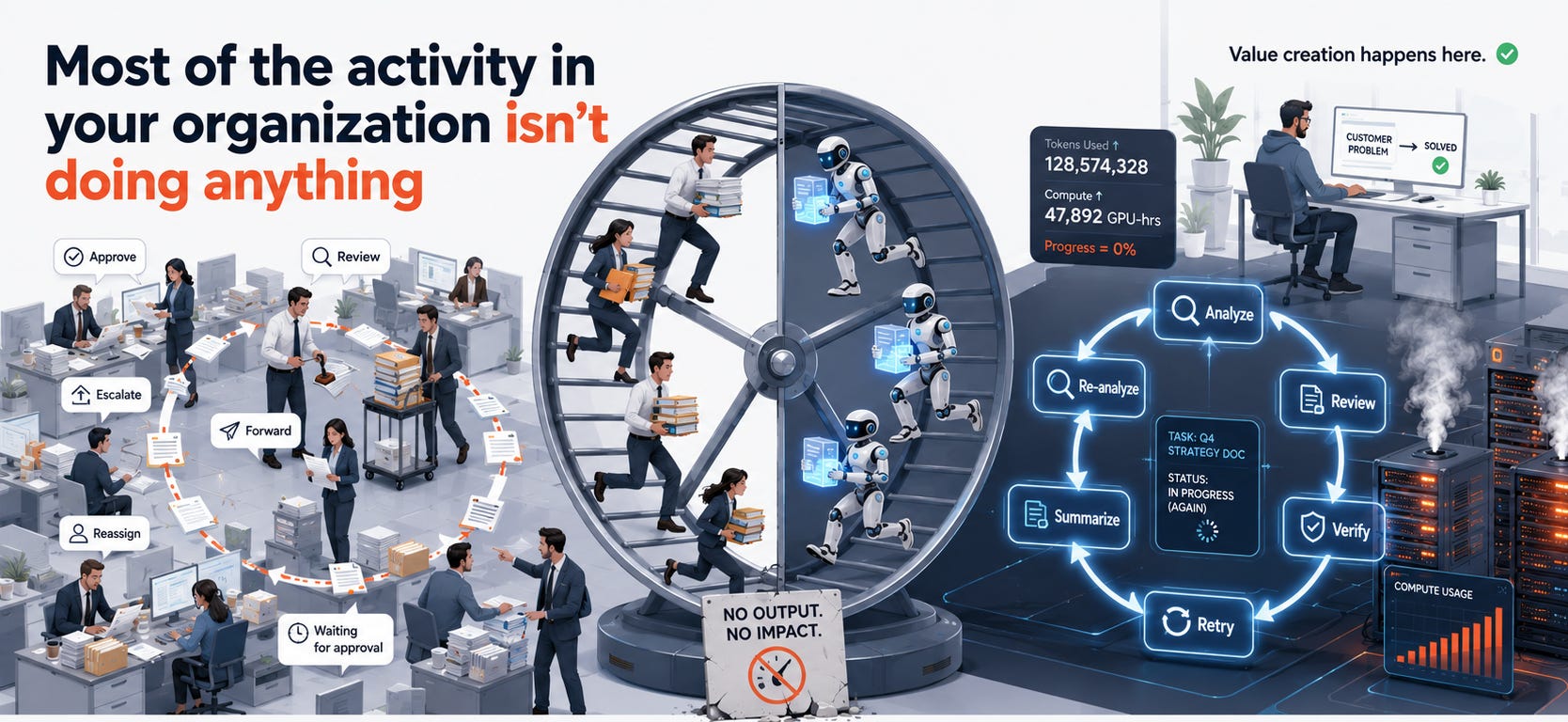
I’ve said this in boardrooms, and I’ll say it here: most large organizations are carrying enormous amounts of activity that doesn’t move anything forward. For instance, people whose job has quietly become approving, escalating, and re-routing work that other people generate to justify their own role in the chain.
AI didn’t invent this pattern. It’s just doing it at a speed that makes it impossible to ignore, and when you don’t design deliberately, waste doesn’t stay small, but compounds, in headcount and in compute, at the exact same rate.
4. The people and the systems that actually move the needle are rare, and you probably don’t know who they are
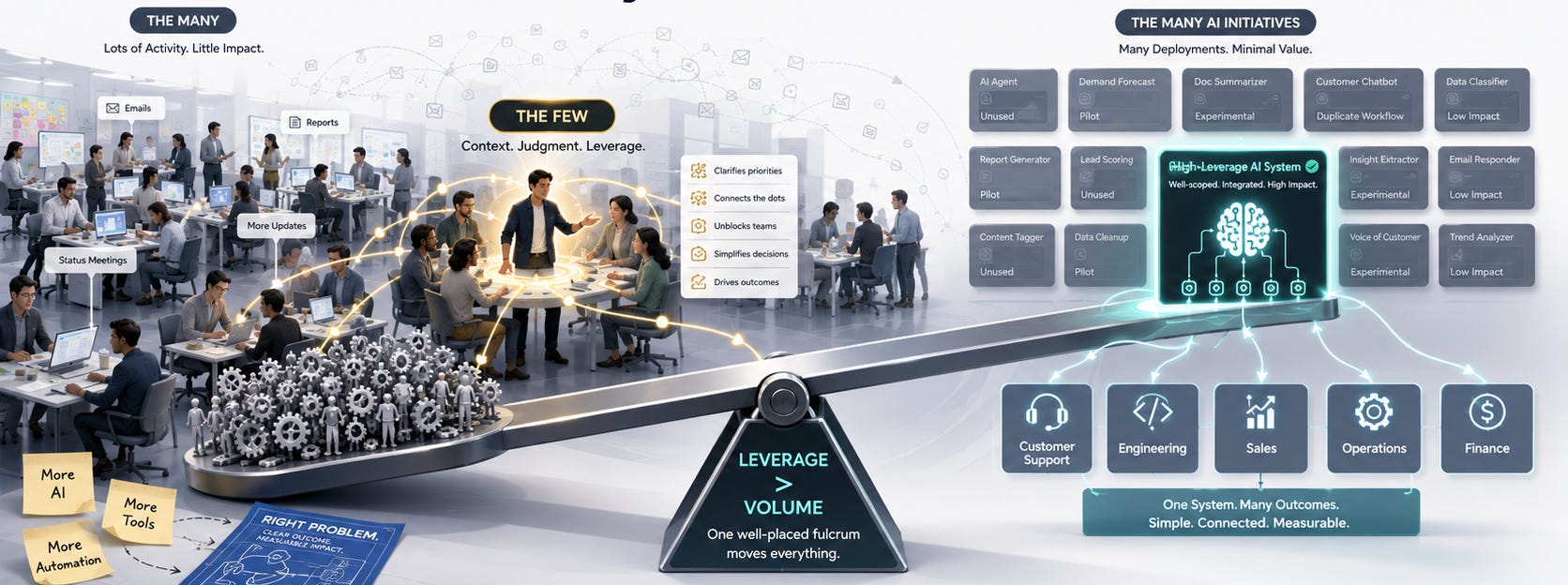
Every organization I’ve worked inside has a small number of people who make everyone around them better just by being in the room. They ask the right question at the right moment, and they carry context nobody wrote down.
The same is proving true of AI. A small number of well-designed, well-scoped deployments are producing outsized results, while the majority sit idle or actively slow things down.
The mistake leaders keep making is assuming that scaling AI means deploying more of it everywhere. It doesn’t work like that. It just means finding where the leverage actually lives and building around that, with the same discipline you’d use to figure out who your highest-leverage people are, and why.
5. Nobody trains their own replacement for free
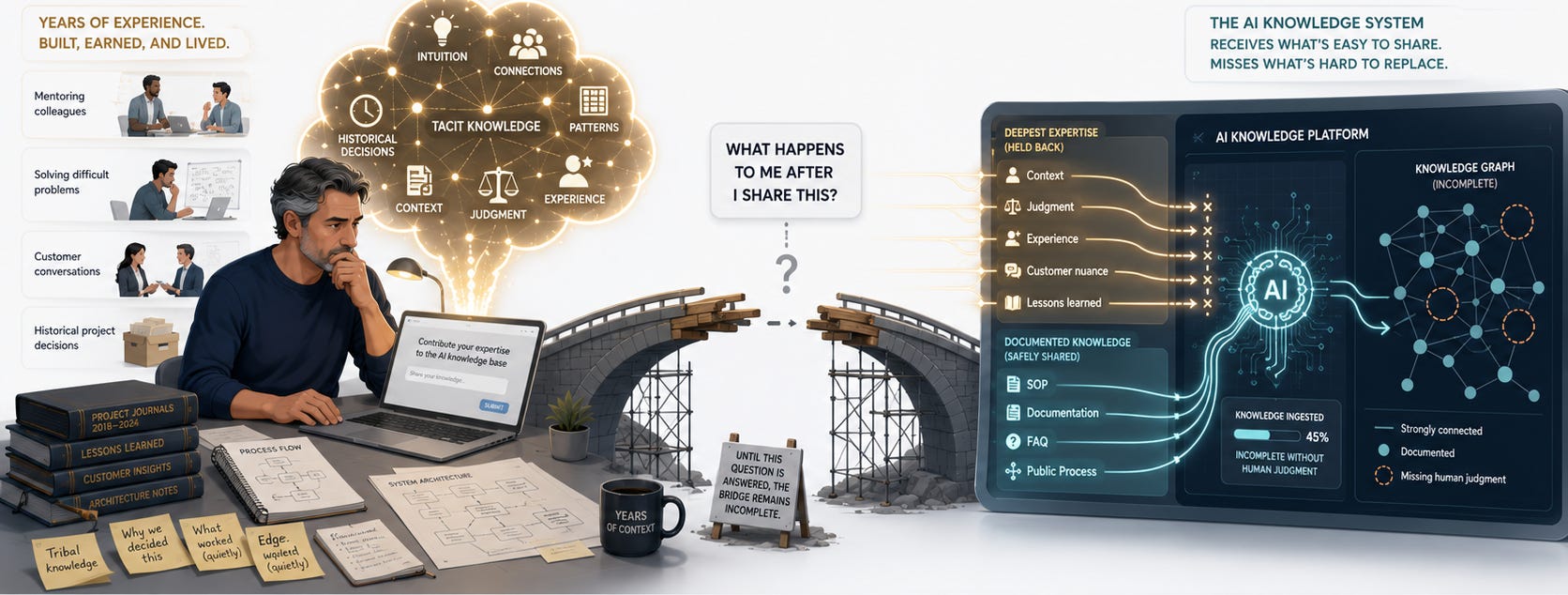
This is the one nobody wants to say out loud, so I will.
The people with the deepest institutional knowledge inside your company are being asked, implicitly or explicitly, to hand that knowledge over to a system many of them correctly suspect is being built to need them less.
I don’t think that’s paranoia. I think it’s rational self-preservation, and it has existed since the first apprentice realized what happens once the master has nothing left to teach.
If you want your best people to actually contribute their hardest-won knowledge to an AI system, you have to answer a question first: what happens to them once they do? If you don’t have an honest answer, don’t expect an honest transfer of knowledge. You’ll just get the polished, safe version, and your AI will be exactly as good as that.
6. You cannot manage what you have never defined
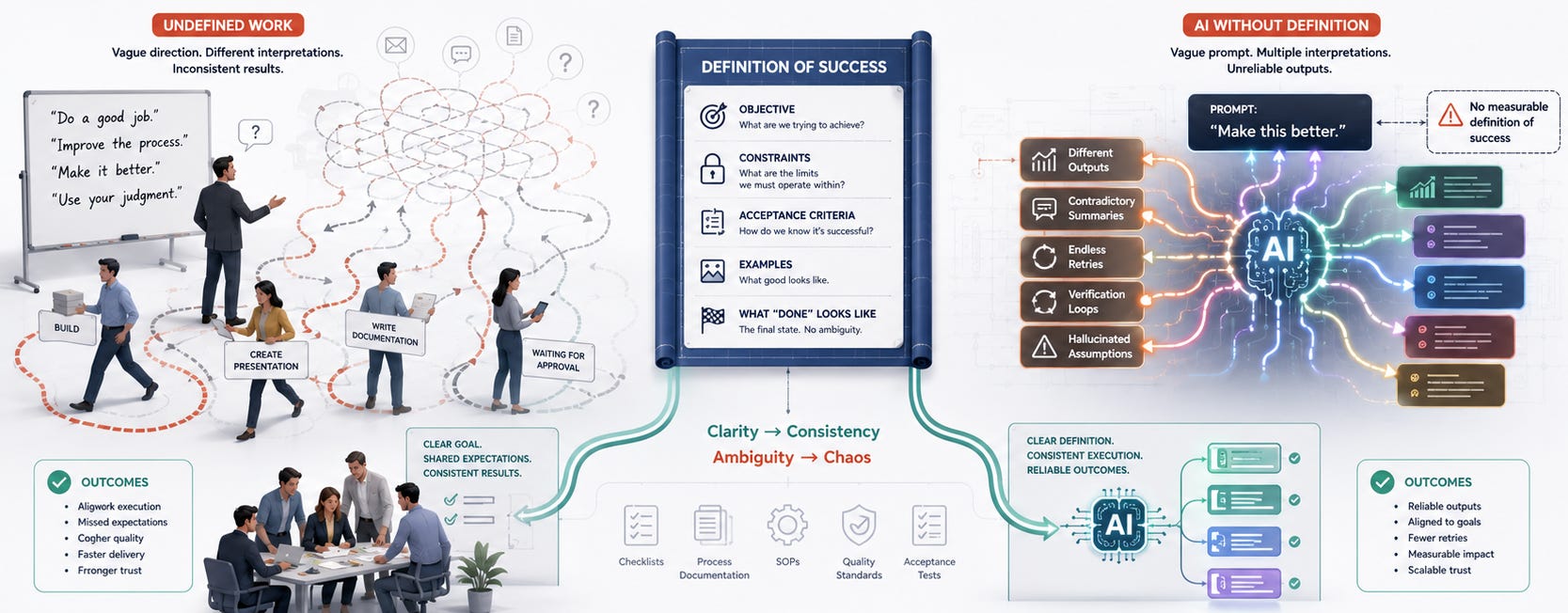
The organizations getting real value out of AI right now are not the ones with the most sophisticated models. They are the ones who did the unglamorous work first: writing down, in specific and testable terms, what a good outcome actually looks like for a given task.
This is the same discipline behind every well-run team I’ve ever seen, with clear standardsand expectations. A definition of success that doesn’t live only in someone’s head, and skip that step with people, and you get inconsistency. Skip it with AI, and you get the exact same inconsistency, just faster and harder to trace back to its source.
7. The next competitive advantage isn’t the tool. It’s whoever learns to run it well
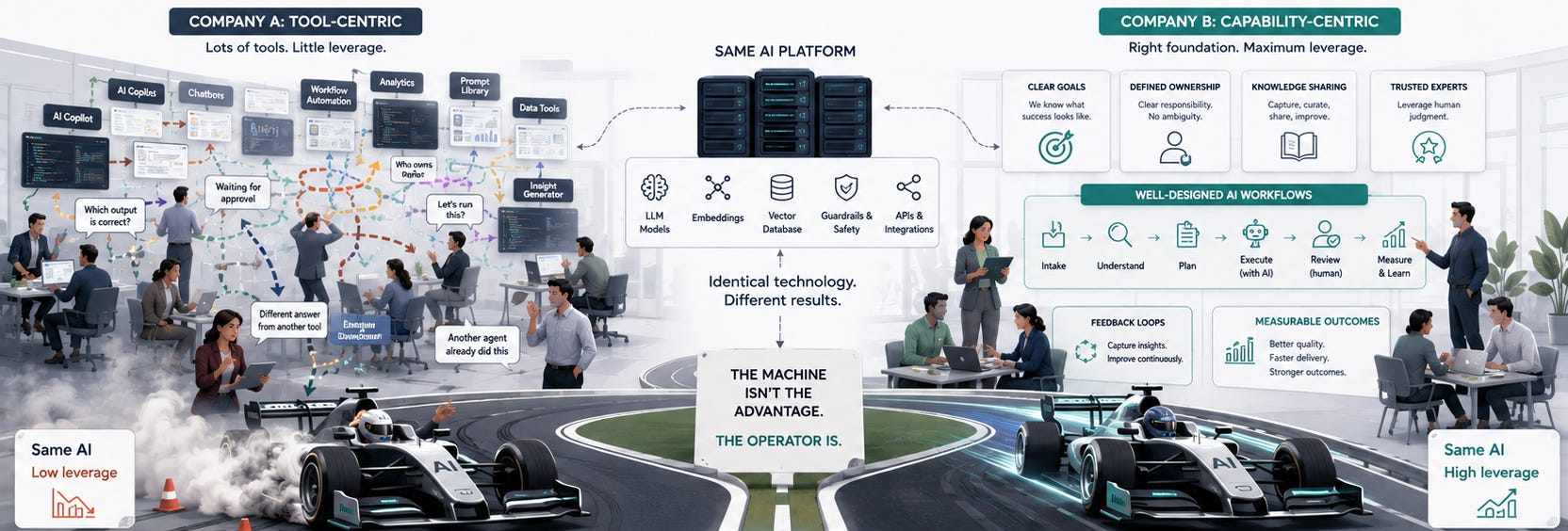
Every company can now buy the same models. Every company can now deploy the same categories of agents. That means the tool itself has stopped being the differentiator, if it ever really was one.
What’s left is the thing that was always scarcest and always hardest to fake: the discipline of actually managing capability well. Defining the work clearly, preserving and rewarding the people who hold real judgment, and building a culture where knowledge gets shared because people trust what happens to them when they share it.
The uncomfortable truth underneath all seven
None of this is really about AI. It has actually never really been about AI.
Every one of these seven patterns existed inside human organizations decades before a single model was trained. AI didn’t create the dysfunction; it just removed the friction that used to hide it, the slow hiring cycles, the natural limits of a person’s time and attention, the fact that a bad manager can only mismanage so many people before the damage becomes visible.
AI has no such limits, and it will scale a bad instruction as fast as a good one, and it will multiply a broken process as efficiently as it multiplies a well-designed one, which is precisely why the leaders who treat this moment as a technology upgrade are going to lose to the leaders who treat it as what it actually is: the most unforgiving audit of management quality any organization has ever been handed.
We didn’t give our people infinite capacity and infinite budget. We gave it to ourselves, disguised as a tool, and called it transformation.
Someone still has to do the oldest job in business, and decide what good looks like. Say it clearly, and mean it enough that the people and the systems around you can actually build toward it.
That was always the job. AI just made it impossible to keep pretending otherwise.
easy to solve. cut staff by 15% in non-customer facing departments and get out of the way. see if they learn to use AI to increase productivity… necessity and all that…
What determines success is the quality of leadership, systems, and the decisions guiding the technology.